Why Is My Broken Tooth Black Inside? Causes and Next Steps
Summary
- A black appearance inside a broken tooth can be caused by decay, trauma or pulp damage.
- Pain may not always be present, even when the tooth has significant internal damage.
- A dental examination and appropriate imaging can determine whether the tooth can be repaired or needs further treatment.
A broken tooth can be alarming on its own, but noticing a dark or black colour inside it often adds another layer of concern. Many people assume it is simply a stain, but a blackened inner tooth can indicate changes happening beneath the surface. Understanding the reason behind this change is important because it may point to decay, trauma or damage that requires timely dental care, shares Dr Rimjhim Saran, an experienced cosmetic dentist in Delhi.
 What Causes a Broken Tooth to Look Black Inside?
When a tooth breaks, its protective outer layers can become damaged and expose the deeper structures. The dark appearance may result from decay, internal damage, old blood from an injury, or changes in the dental pulp. The exact cause cannot be determined simply by looking at the tooth, which is why a dental examination is important.
“A blackened area inside a broken tooth is not something to judge by appearance alone. It can be a warning sign of deeper damage that deserves professional evaluation.” Says Cosmetic Dental Surgeon in Delhi, Dr Rimjhim Saran Bhatnagar.
Deep Tooth Decay
One common reason for darkening inside a broken tooth is extensive tooth decay. As decay progresses deeper into the tooth, the affected structure can become brown, grey or black. When a fracture exposes this area, the discolouration may suddenly become much more visible.
If decay has reached the pulp, the tooth may require root canal treatment rather than a simple filling.
Damage to the Dental Pulp
The pulp contains the nerves and blood vessels inside the tooth. A fracture or previous trauma can damage this tissue. If the pulp becomes severely inflamed or dies, the tooth can gradually become darker.
Importantly, a tooth does not always remain painful after the pulp has been damaged. A reduction in pain does not necessarily mean that the problem has resolved.
Previous Trauma
A tooth that was hit or injured, even months or years earlier, can sometimes develop internal discolouration later. Blood products released inside the tooth during the original injury can contribute to a grey, brown or black appearance.
This is particularly relevant when a previously injured tooth later becomes darker or breaks.
Old Dental Work
Older fillings, crowns or other dental restorations can sometimes contribute to a darker appearance. Materials used in previous dental treatment may show through the tooth or become discoloured over time.
A dentist can determine whether the darkness is related to the restoration or to damage within the tooth itself.
A Crack Can Allow Bacteria to Enter
When a tooth breaks or develops a deep crack, bacteria can gain access to areas that were previously protected. This can increase the risk of decay and infection.
A cracked tooth should therefore not be ignored simply because the initial discomfort is mild.
Signs That Need Prompt Attention
Pain when biting, prolonged sensitivity to hot or cold, swelling around the tooth, tenderness in the gums, bad taste, pus, or increasing discolouration can indicate a more serious dental problem.
A broken tooth with facial swelling or severe pain needs prompt professional evaluation. Fever, rapidly increasing swelling, or difficulty swallowing or breathing requires urgent medical attention.
What Will the Dentist Do?
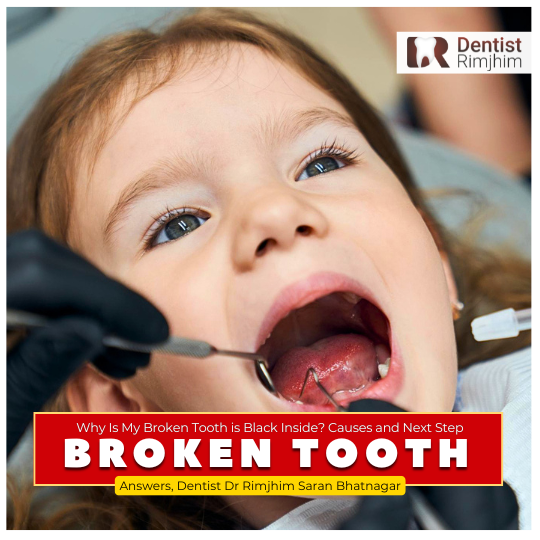
The dentist will examine the broken tooth and may recommend an X-ray or other imaging to understand what is happening below the surface. Treatment depends on the extent of the damage.
A minor fracture may sometimes be repaired with a filling, bonding or another restoration. More extensive damage may require a crown, while a tooth with infected or damaged pulp may need root canal treatment followed by restoration.
In some cases, when the tooth cannot be predictably restored, extraction may be considered.
Do Not Try to Treat the Dark Area Yourself
Scraping, drilling or applying home remedies to the dark portion of a broken tooth can cause further damage. Painkillers may temporarily control discomfort, but they cannot repair the fracture or treat an infection.
The sooner the tooth is examined, the sooner the appropriate treatment can be planned.

With an illustrious career spanning nearly two decades, Delhi’s best dentist, the leading dentist who specialises in root canal treatment, dental implants, pediatric dentistry, cosmetic dentistry, dental surgeries, and more, Dr Rimjhim Saran Bhatnagar, is a highly skilled and experienced dental specialist committed to providing exceptional patient care. Her expertise encompasses a comprehensive range of advanced dental procedures, from routine oral care to complex restorative and cosmetic treatments.
Dr. Rimjhim holds a Bachelor of Dental Surgery (BDS) and a Master’s Degree in Oral Medicine, Oral Diagnosis, and Oral Radiology. With over 12 years of experience working in some of the leading Delhi government hospitals, she has earned a reputation as one of the best dentists in Delhi, the best dental surgeons in Delhi, and a top cosmetic dentist in Delhi.… Read More