Does Salt Water Really Heal Tooth Infections? Myth or Remedy
Summary
- Salt water may provide temporary relief.
- It cannot cure a deep tooth infection.
- Persistent symptoms require dental treatment.
 A sudden toothache, swollen gums, or pain while chewing can make anyone search for quick home remedies. One of the most common suggestions people hear is saltwater rinsing. But can something as simple as salt and warm water actually heal a tooth infection, or is it just temporary relief? The truth lies somewhere between myth and remedy, explains Dr Rimjhim Saran Bhatnagar, one of the experienced dentists in Delhi.
Salt water rinsing has been used as a simple oral-care practice for generations. Warm salt water may help cleanse the mouth, reduce irritation, and provide temporary relief from gum discomfort. However, it is important to understand that rinsing cannot eliminate an infection that has developed inside a tooth or deep within the surrounding tissues, as Dr Rimjhim Saran Bhatnagar, who is an experienced dental surgeon in Delhi, Gurugram, and Noida, explains.
Can Salt Water Actually Treat a Tooth Infection?
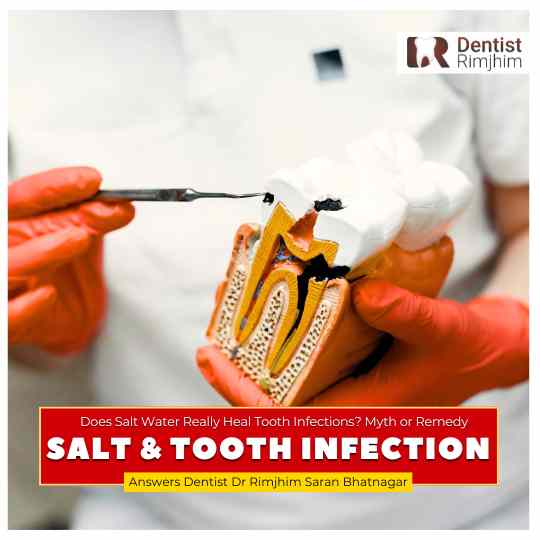
Salt water can support oral hygiene and may temporarily ease certain symptoms, but it cannot cure the underlying cause of a tooth infection. A dental infection can involve bacteria reaching the inner part of the tooth, often because of deep decay, cracks, or damage. Professional dental treatment is usually necessary to remove the source of infection and prevent it from spreading.
“Salt water may soothe an infected tooth, but only proper dental treatment can address the infection at its source.” Opines Dr Rimjhim Saran Bhatnagar, Senior dental surgeon in Delhi.
 It May Reduce Irritation
Rinsing gently with warm salt water can help clean the mouth and may soothe irritated gums. It can also help remove food particles and debris around the affected area.
This can make the mouth feel cleaner and more comfortable, but symptom relief should not be confused with curing the infection.
It Can Provide Temporary Pain Relief
Warm salt water may provide short-term relief from gum soreness and inflammation. For someone experiencing discomfort while waiting for a dental appointment, a gentle rinse may be a useful supportive measure.
However, if pain returns repeatedly or becomes more severe, the underlying dental problem needs professional attention.
It Does Not Remove Deep Infection
A tooth infection cannot simply be rinsed away. When bacteria reach the pulp or deeper structures of a tooth, treatment may require procedures such as root canal treatment or, in severely damaged cases, tooth removal.
Salt water cannot reach and eliminate bacteria located deep inside an infected tooth.
Delaying Treatment Can Make Problems Worse
One of the biggest risks of relying only on home remedies is delaying proper dental care. An infection may temporarily feel better while the underlying problem continues to progress.
Untreated dental infections can potentially spread to surrounding tissues and cause more serious complications. This is why persistent tooth pain, swelling, or sensitivity should not be ignored.
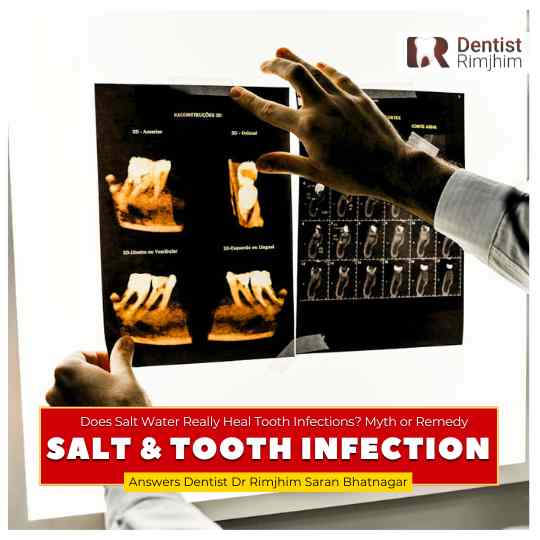 Proper Dental Evaluation Is Important
A dentist can identify the source and severity of an infection through an examination and, when necessary, dental imaging. Treatment is then selected according to the condition of the tooth and surrounding tissues.
Early treatment can often prevent a relatively manageable dental problem from becoming more complicated.
Salt Water Should Be Used Gently
If a dentist recommends or approves salt water rinsing, it should be used as a supportive measure rather than a replacement for treatment. Rinsing gently is preferable to aggressively swishing, particularly when the gums or tooth are already painful.
Maintaining regular brushing, cleaning between the teeth, and attending dental check-ups remains important for preventing future oral health problems.
Salt water is more than just a myth when it comes to oral care, because a warm salt water rinse can provide temporary relief and help keep the mouth cleaner. However, it should not be considered a cure for a tooth infection. Once an infection has reached deeper structures of the tooth or surrounding tissues, professional dental treatment is needed to address the actual cause. Anyone experiencing persistent toothache, swelling, pain while chewing, or other signs of infection should consult a dentist rather than relying solely on home remedies.

With an illustrious career spanning nearly two decades, Delhi’s best dentist, the leading dentist who specialises in root canal treatment, dental implants, pediatric dentistry, cosmetic dentistry, dental surgeries, and more, Dr Rimjhim Saran Bhatnagar, is a highly skilled and experienced dental specialist committed to providing exceptional patient care. Her expertise encompasses a comprehensive range of advanced dental procedures, from routine oral care to complex restorative and cosmetic treatments.
Dr. Rimjhim holds a Bachelor of Dental Surgery (BDS) and a Master’s Degree in Oral Medicine, Oral Diagnosis, and Oral Radiology. With over 12 years of experience working in some of the leading Delhi government hospitals, she has earned a reputation as one of the best dentists in Delhi, the best dental surgeons in Delhi, and a top cosmetic dentist in Delhi.… Read More